Book 15 Minutes
Consultation, NO FEES
x 13April26

Everyone is talking about Agentforce

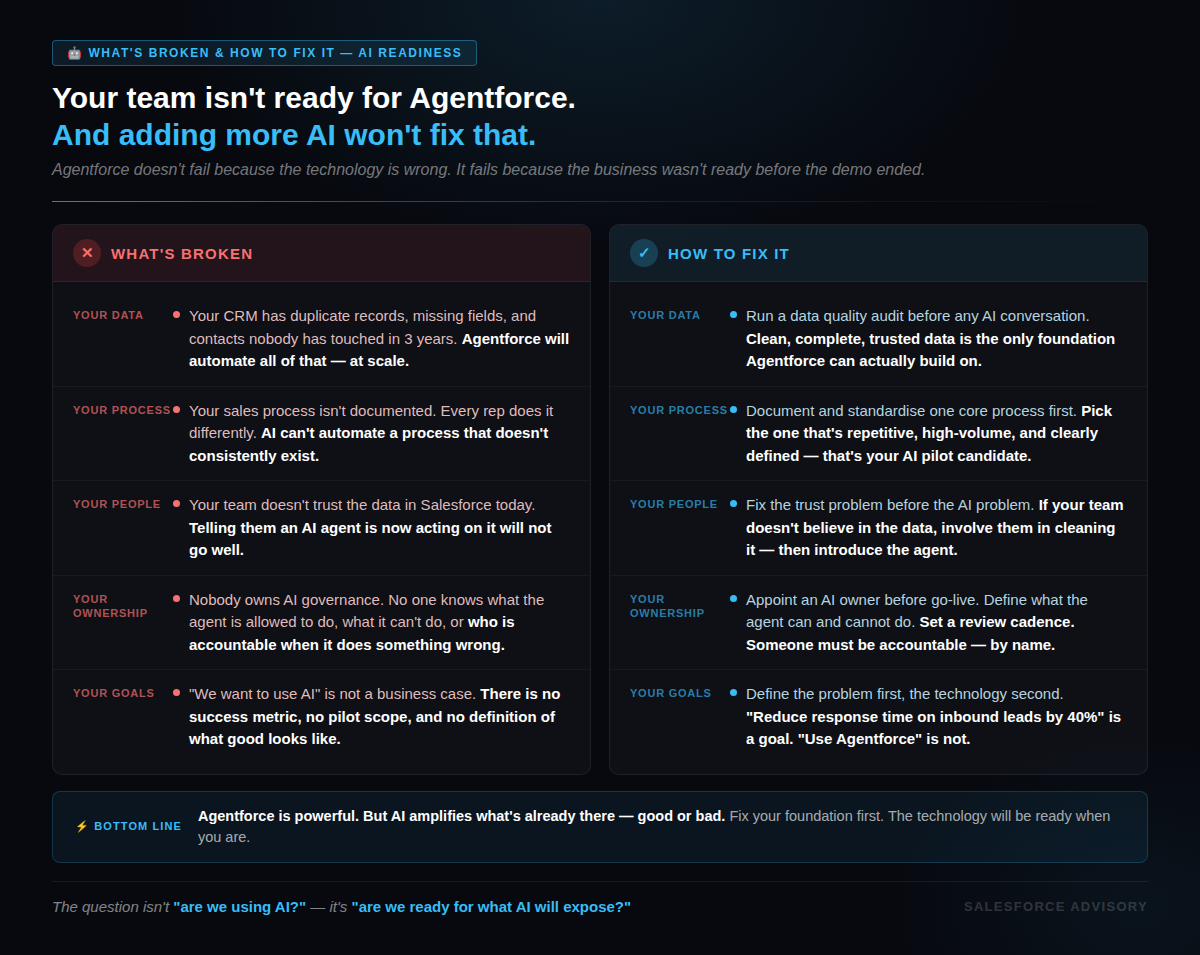
Half the companies I speak to are already planning to implement it. Almost none of them are ready. Here’s what’s actually broken — and what to fix before you spend a penny on AI. 🔴 What’s Broken Your data: Your CRM has duplicate records, missing fields, and contacts nobody has touched in 3 years. Agentforce will automate all of that — at scale. Your process: Your sales process isn’t documented. Every rep does it differently. AI can’t automate a process that doesn’t consistently exist. Your people: Your team doesn’t trust the data in Salesforce today. Telling them an AI agent is now acting on it will not go well. Your ownership: Nobody owns AI governance. No one knows what the agent is allowed to do, what it can’t, or who is accountable when it does something wrong. Your goals: “We want to use AI” is not a business case. There is no success metric, no pilot scope, no definition of what good looks like. 🔵 How to Fix It Your data: Run a data quality audit before any AI conversation. Clean, complete, trusted data is the only foundation Agentforce can build on. Your process: Document and standardise one core process first. Pick the one that’s repetitive, high-volume, and clearly defined — that’s your pilot candidate. Your people: Fix the trust problem before the AI problem. Involve your team in cleaning the data — then introduce the agent. Your ownership: Appoint an AI owner before go-live. Define what the agent can and cannot do. Someone must be accountable — by name. Your goals: Define the problem first, the technology second. “Reduce response time on inbound leads by 40%” is a goal. “Use Agentforce” is not. Agentforce is powerful. But AI amplifies what’s already there — good or bad. Fix your foundation first. The technology will be ready when you are. The question isn’t “are we using AI?” It’s “are we ready for what AI will expose?” ♻️ Tag a CTO or VP of Sales who’s in an Agentforce conversation right now.

Everyone is talking about Agentforce Read Post »
x 13April26

Everyone is talking about Agentforce

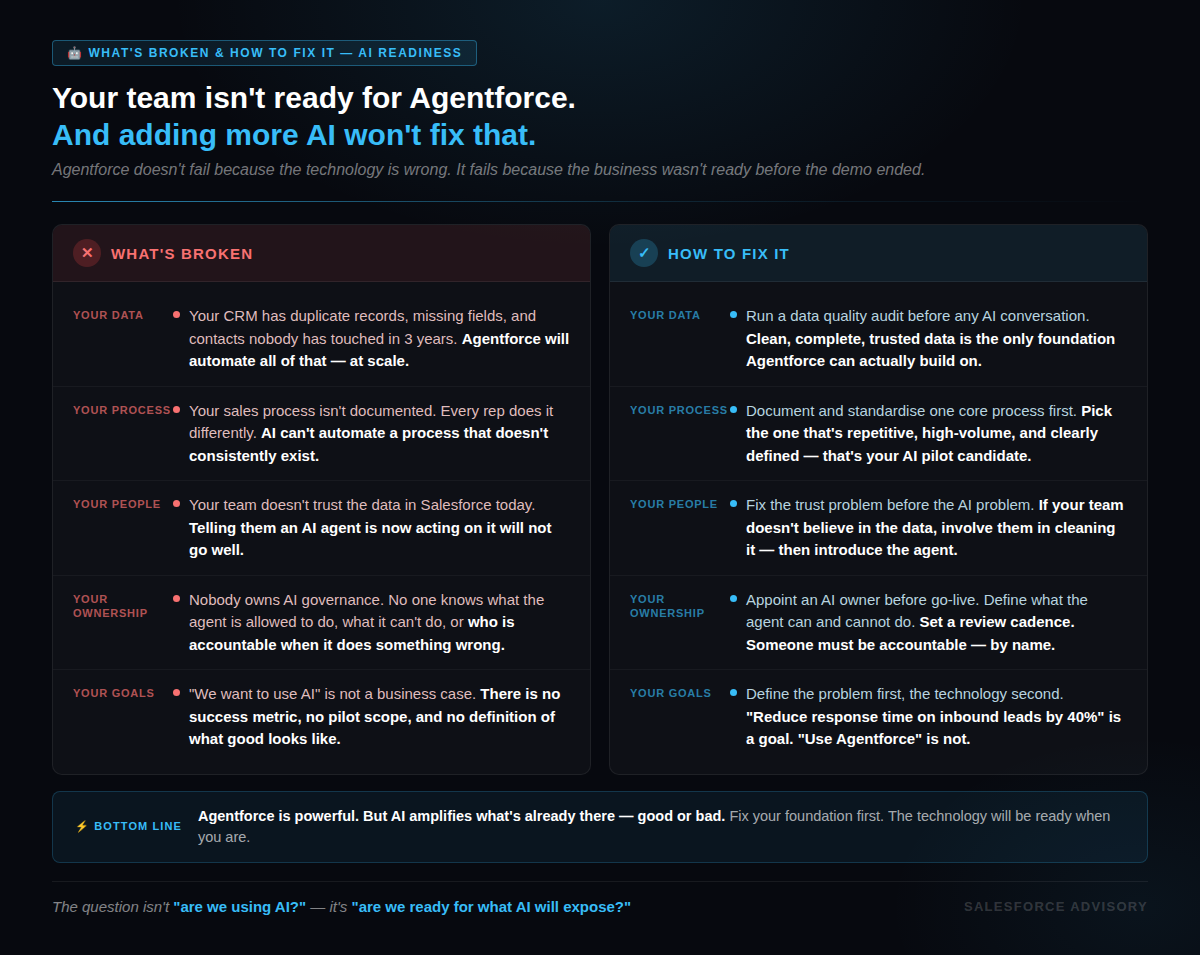
Half the companies I speak to are already planning to implement it. Almost none of them are ready. Here’s what’s actually broken — and what to fix before you spend a penny on AI. 🔴 What’s Broken Your data: Your CRM has duplicate records, missing fields, and contacts nobody has touched in 3 years. Agentforce will automate all of that — at scale. Your process: Your sales process isn’t documented. Every rep does it differently. AI can’t automate a process that doesn’t consistently exist. Your people: Your team doesn’t trust the data in Salesforce today. Telling them an AI agent is now acting on it will not go well. Your ownership: Nobody owns AI governance. No one knows what the agent is allowed to do, what it can’t, or who is accountable when it does something wrong. Your goals: “We want to use AI” is not a business case. There is no success metric, no pilot scope, no definition of what good looks like. 🔵 How to Fix It Your data: Run a data quality audit before any AI conversation. Clean, complete, trusted data is the only foundation Agentforce can build on. Your process: Document and standardise one core process first. Pick the one that’s repetitive, high-volume, and clearly defined — that’s your pilot candidate. Your people: Fix the trust problem before the AI problem. Involve your team in cleaning the data — then introduce the agent. Your ownership: Appoint an AI owner before go-live. Define what the agent can and cannot do. Someone must be accountable — by name. Your goals: Define the problem first, the technology second. “Reduce response time on inbound leads by 40%” is a goal. “Use Agentforce” is not. Agentforce is powerful. But AI amplifies what’s already there — good or bad. Fix your foundation first. The technology will be ready when you are. The question isn’t “are we using AI?” It’s “are we ready for what AI will expose?” ♻️ Tag a CTO or VP of Sales who’s in an Agentforce conversation right now.

Everyone is talking about Agentforce Read Post »
x 12April26

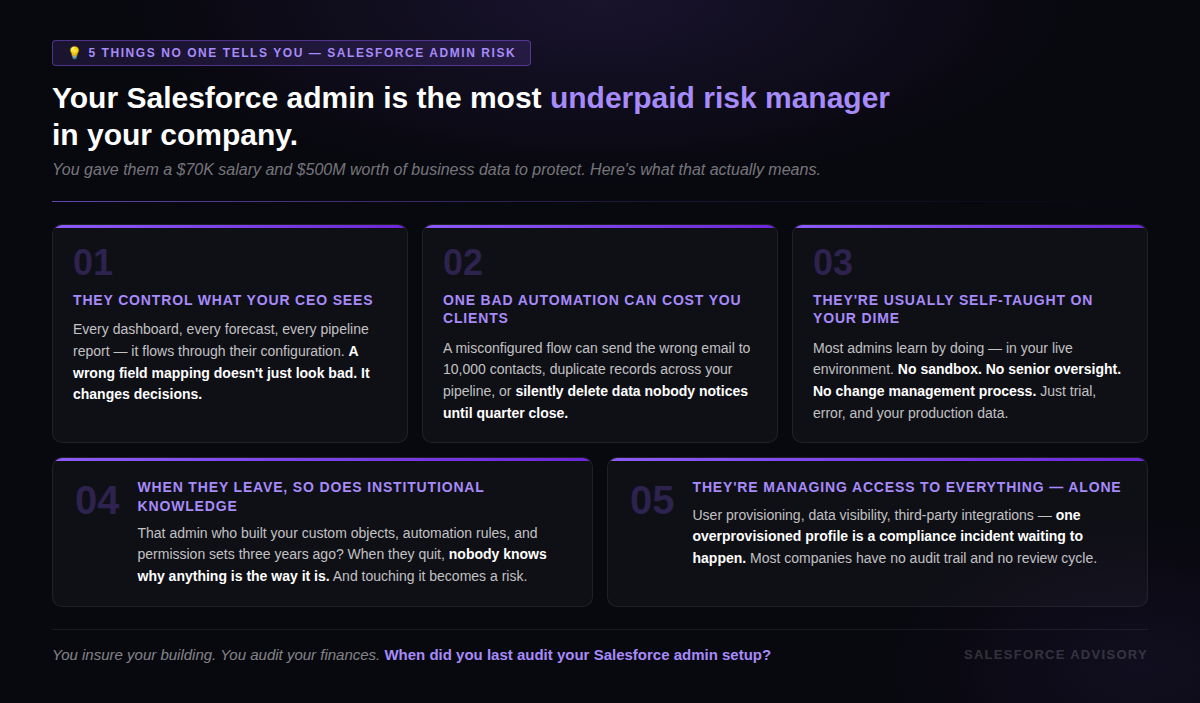
Your Salesforce Admin is the most UNDERPAID RISK MANAGER in your Company

They control what your CEO sees. They touch every deal, every forecast, every customer record. Here are 5 things nobody tells you about that decision. Every dashboard, every forecast, every pipeline report flows through their configuration. A wrong field mapping doesn’t just look bad. It changes decisions worth millions. A misconfigured workflow can send the wrong email to 10,000 contacts, duplicate records across your pipeline, or silently delete data nobody notices until quarter close. Most admins learn by doing. In your production environment. No senior oversight. No formal change management. Just trial, error, and your real customer data. That admin who built your custom objects and automation three years ago? When they quit, nobody knows why anything is the way it is. And touching it becomes a business risk. User provisioning, data visibility, third-party integrations. One overprovisioned profile is a compliance incident waiting to happen. Most companies have no audit trail and no review cycle. When did you last audit your Salesforce admin setup? If the answer is “never” — that’s the risk hiding in plain sight. ♻️ Tag a COO or CFO who needs to read this.

Your Salesforce Admin is the most UNDERPAID RISK MANAGER in your Company Read Post »

x 11April2026

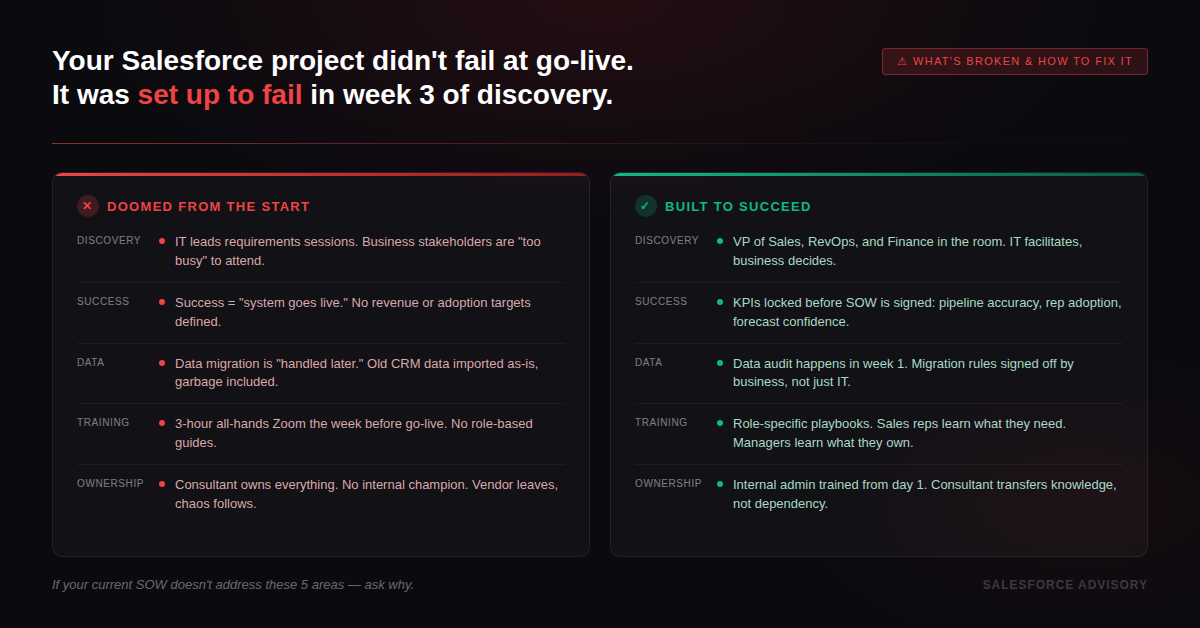
Most Salesforce projects don’t fail at go-live

They fail in week 3 of discovery — when nobody asked the right questions. Here’s what I see constantly when I sit thru those meetings: <<How projects get doomed>> Discovery: IT runs the requirements sessions. Business leaders are “too busy” — until the system fails them. Success: Go-live IS the goal. No revenue targets, no adoption benchmarks, no accountability after the launch party. Data: Migration is deferred to the end. Old CRM garbage is imported as-is — then everyone wonders why the reports are wrong. Training: One all-hands Zoom the week before go-live. No role-based guides. No follow-up. Ownership: The consultant owns everything. When they leave, your team is helpless. <<How winning projects run>> Discovery: VP of Sales, RevOps, and Finance are in every session. IT facilitates. Business decides. Success: KPIs are locked before the SOW is signed — pipeline accuracy, rep adoption rate, forecast confidence. Data: Audit happens in week 1. Migration rules are approved by business owners, not just the IT lead. Training: Role-specific playbooks. Sales reps learn their workflow. Managers learn what they own and can see. Ownership: An internal admin is trained from day 1. The consultant’s job is to transfer knowledge — not create dependency. I’ve seen $500K implementations fail on every single one of these points. Not because the technology was wrong. Because the process was never set up to protect the buyer. If your SOW doesn’t address these 5 areas — ask why before you sign. Repost if this would have helped someone you know before their last implementation.

Most Salesforce projects don’t fail at go-live Read Post »

x 10April2026

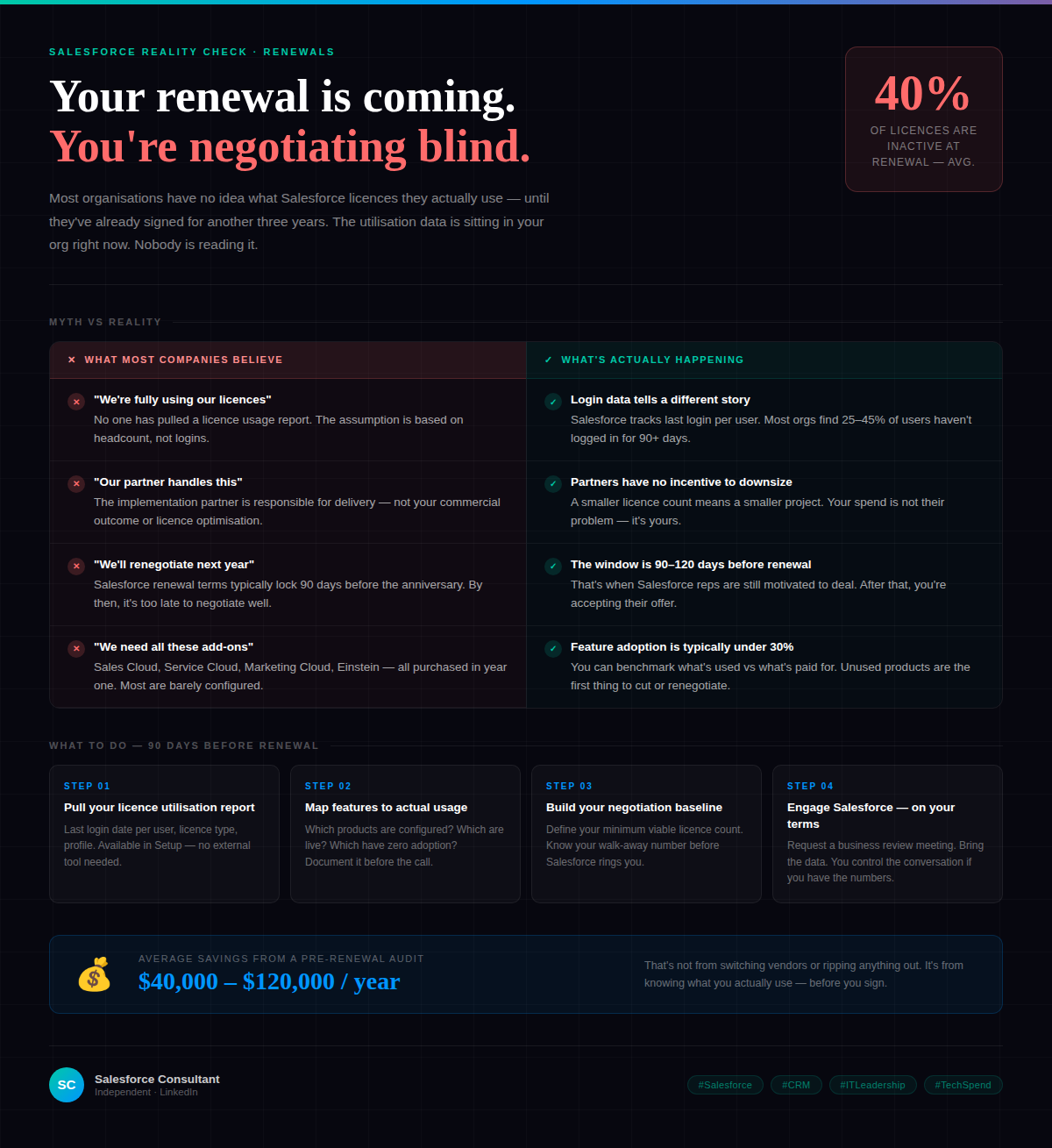
Your Salesforce renewal is coming. And you are Negotiating Blind.

Even before you’ve picked up the phone, Salesforce has already internally booked a 10% increase on your account. Most CTOs and IT leaders walk into that conversation with nothing. No license data. No usage audit. No benchmark. Just the number on the email — and a rep who sounds very friendly. Here’s what’s actually happening: ❌ “We’re fully using our licences” → 25–45% of licensed users haven’t logged in for 90+ days. The data is in your Setup page. Nobody is looking. ❌ “We can reduce licences if we need to” → If you try to reduce from 100 to 80 users, Salesforce raises the per-user rate to protect total revenue. Per-user hikes of 30–50% have been documented. Without a reduction provision clause in your contract, you have no protection whatsoever. ❌ “The 7–8% uplift is manageable” → A $150,000 contract at 7% annual uplift becomes $212,000 in five years. With no new users. No new features. Add consultant dependency, storage overages, and add-on repricing — and the real annual increase is often 12–18%. ❌ “We’ll renegotiate next year” → The window is 90–120 days before renewal. That’s when Salesforce reps are still motivated to deal. Salesforce’s fiscal year ends January 31 — Q4 reps are the most flexible. After the renewal lands, you’re accepting their offer. ❌ “We need all these add-ons” → Feature adoption across most orgs is under 30%. Salesforce bundles products into renewal offers to mask price increases. Ask for itemised pricing. Remove anything not fully deployed before you sign. The average savings from a pre-renewal audit: $40,000 – $120,000 per year. Not from switching. Not from a project. Just from knowing what you actually have — before you’re asked to sign for three more years of it. 💬 Have you ever pulled a licence utilisation report before a Salesforce renewal? What did you find?

Your Salesforce renewal is coming. And you are Negotiating Blind. Read Post »

x 09April2026

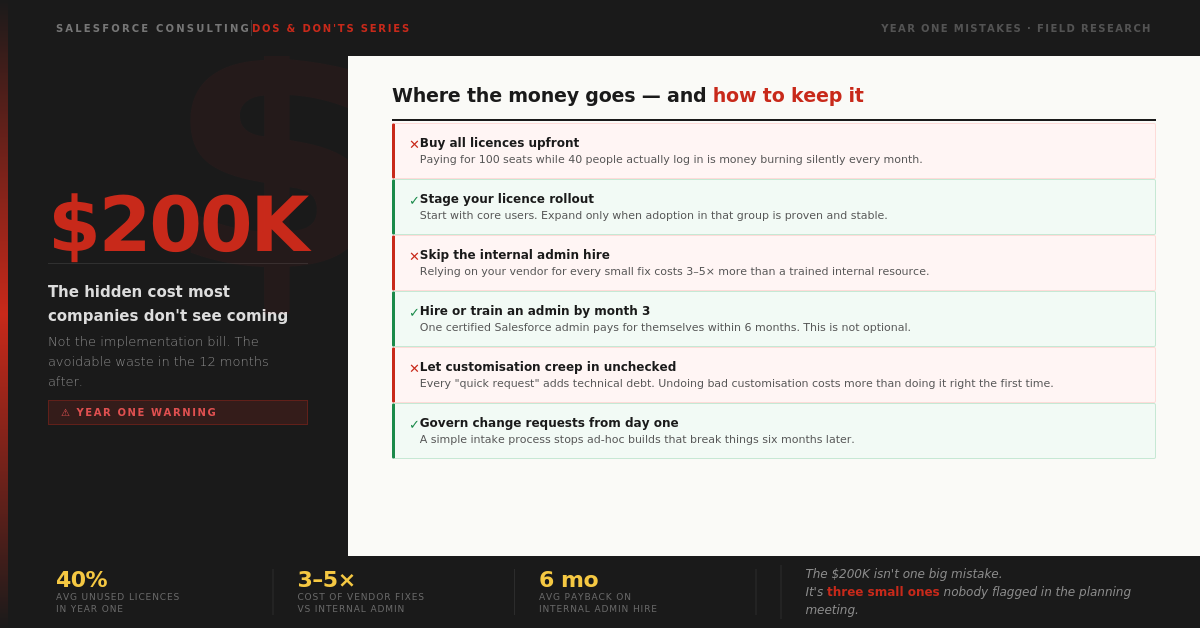
Nobody gets a $200K invoice for wasting money on Salesforce

It doesn’t come in one bill. It comes in three quiet ones — that nobody flags until year two. Here’s where it goes: Mistake #1: Buying all your licences upfront. ❌ DON’T pay for 100 seats when 40 people are logging in. ✅ DO stage your rollout. Start with core users. Expand only when adoption in that group is real and measurable. A manufacturing firm paid for 120 Enterprise licences from day one. 14 months later, their utilisation report showed 47 active users. That’s $73K in unused seats — per year. Mistake #2: Not hiring an internal admin. ❌ DON’T rely on your implementation vendor for every small change after go-live. ✅ DO hire or train a Salesforce admin by month 3. One certified admin pays for themselves in under 6 months. A financial services company called their vendor for every report tweak, every field change, every user access update. Their “small requests” bill in year one: $94K. A mid-level Salesforce admin costs less than half that. Mistake #3: Letting customisation happen without governance. ❌ DON’T say yes to every “quick request” from department heads. ✅ DO build a simple change request intake process from day one. Every ad-hoc build creates technical debt that costs more to undo than to have done properly. One retail client came to us 18 months post go-live. Their org had 47 custom fields nobody could explain, 12 automation rules that conflicted with each other, and a build that needed a near-full rebuild. Cost: $110K. The original “quick requests” that caused it? Each one was under $2K at the time. The $200K isn’t one catastrophic decision. Which of these three has cost your organisation the most? 👇 Save this for your next Salesforce planning meeting.

Nobody gets a $200K invoice for wasting money on Salesforce Read Post »

x 08April2026

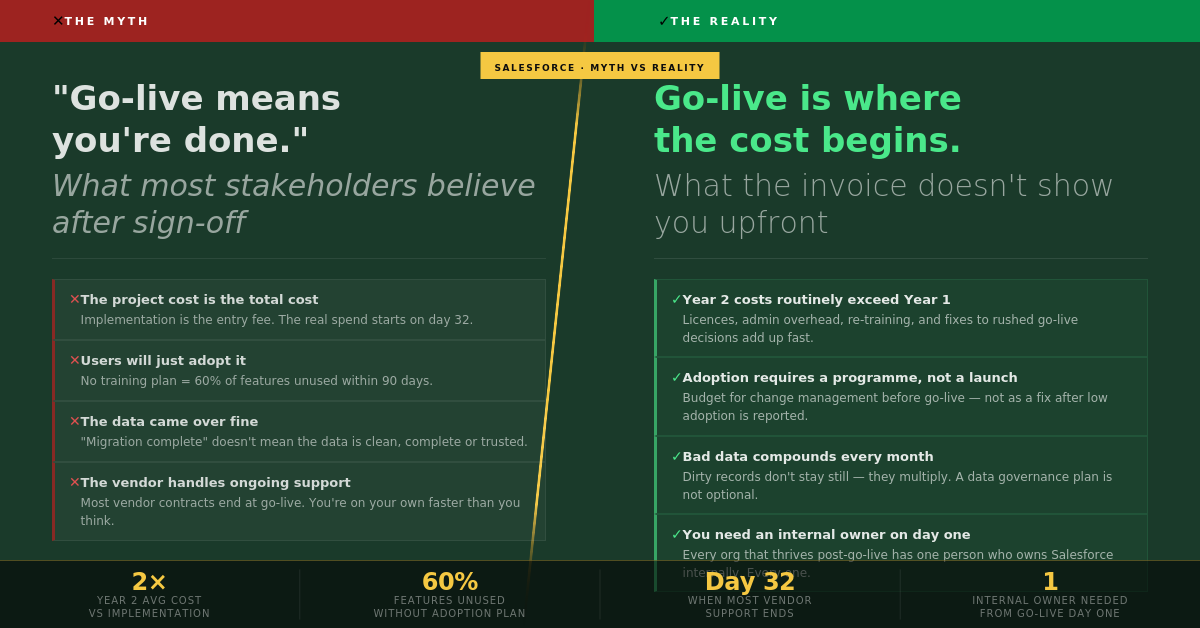
Everyone celebrates go-live

The cake. The all-hands. The screenshots of the new dashboards. And then, about 90 days later, the questions start. “Why aren’t the reps using it?”“Why is the forecast still wrong?”“Why does it cost this much to run?” Here’s the uncomfortable truth most vendors won’t tell you before you sign: REALITY: Year 2 routinely costs more than the implementation itself — licences, admin overhead, re-training, and fixes to decisions that were rushed to hit a go-live date. MYTH: Users will just adopt it. REALITY: Without a dedicated change management programme, 60% of features go unused within 90 days. A launch email is not a training plan. MYTH: The data came over fine. REALITY: “Migration complete” means the data moved. It doesn’t mean it’s clean, trusted, or usable. Dirty records don’t stay still — they multiply every single month. MYTH: The vendor handles ongoing support. REALITY: Most vendor contracts end at go-live. By day 32, you’re largely on your own. If your Salesforce implementation is more than 6 months old and the team still isn’t fully using it — the problem isn’t the platform. What surprised you most about the cost of running Salesforce after go-live? 👇

Everyone celebrates go-live Read Post »

x 07April2026

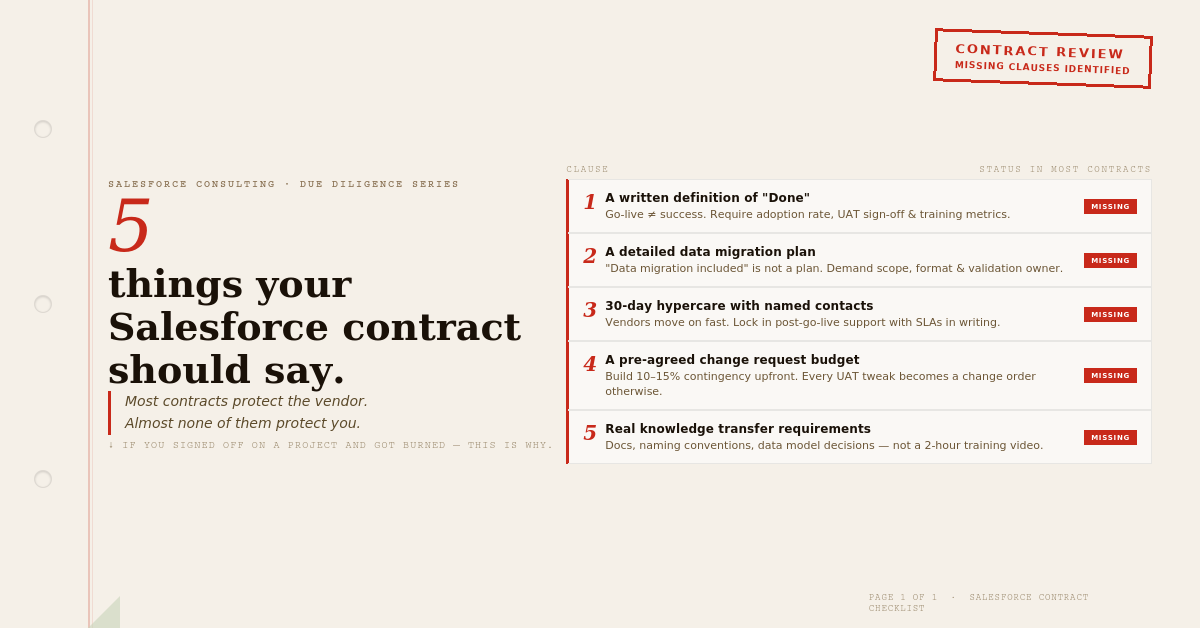
I have reviewed dozens of Salesforce implementation contracts

Most of them protect the vendor. Almost none of them protect you. Here are 5 things your contract should say — and usually doesn’t: Real example: A mid-size logistics company paid $400K for a “completed” Salesforce build. Their sales team refused to use it. The contract said go-live happened. It did. No one defined usable. Real example: A professional services firm lost 6 years of account history during migration. It was “included.” The scope of what “included” meant was never defined. Real example: A retail company went live on a Friday. By Monday, the support team had moved to a new project. 11 days of downtime followed. Real example: A $250K project ballooned to $390K. Every business process tweak during UAT triggered a change order. The vendor wasn’t wrong — the contract allowed it. Real example: A company’s lead Salesforce admin left 8 months after go-live. Nobody knew how any of it was built. A $180K re-implementation followed. The best Salesforce implementations I’ve seen had one thing in common: The contract was written like the vendor might disappear on day 31.Because sometimes, they do. Save this. Share it with whoever signs your next technology contract. What clause do you wish you’d had? Drop it below. 👇

I have reviewed dozens of Salesforce implementation contracts Read Post »

06April2026

Your Agentforce implementation isn’t failing because of the technology.

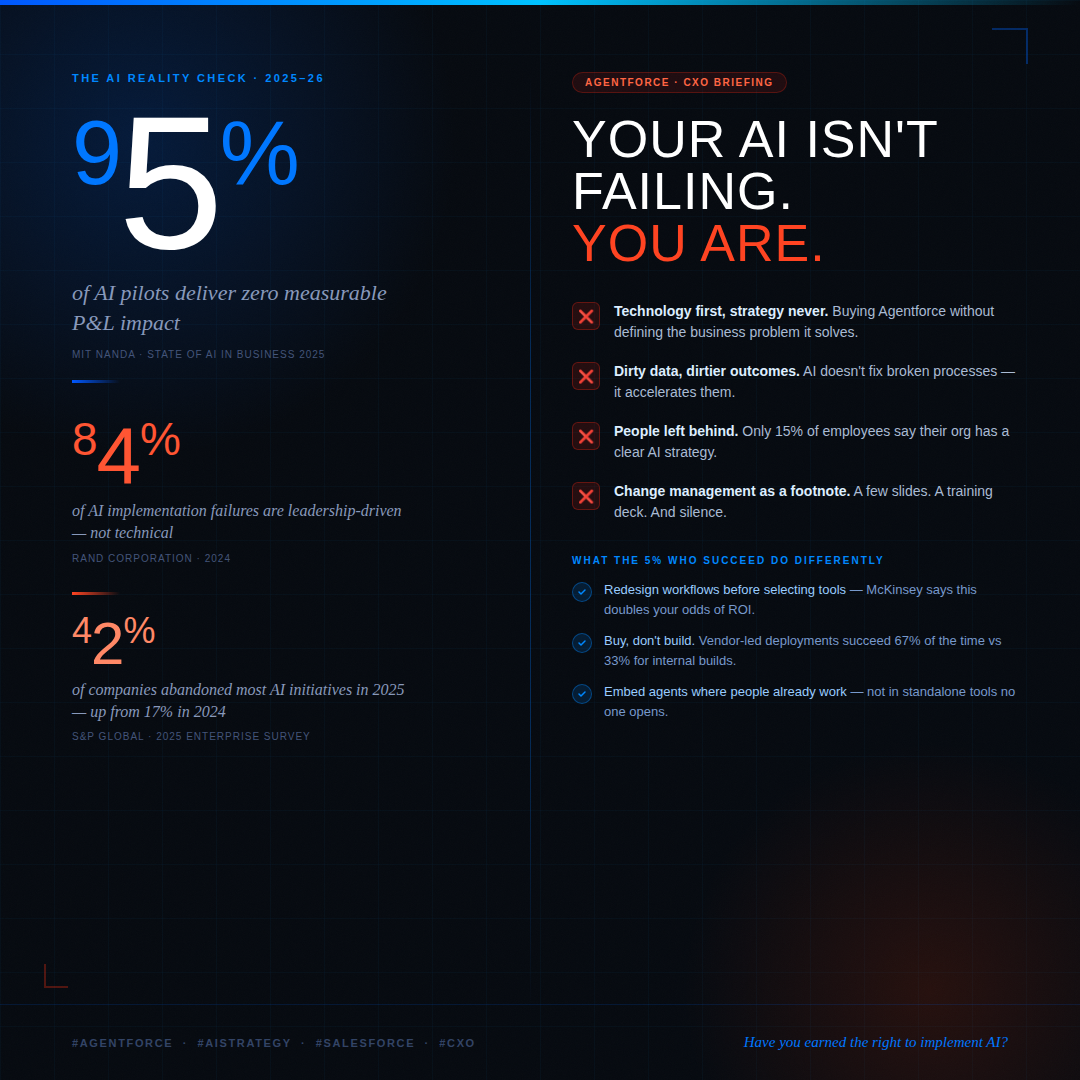
It’s failing because of you. That’s uncomfortable. But the data doesn’t lie. More than 80% of AI projects fail — that’s twice the failure rate of non-AI technology projects. RAND And 95% of organizations running AI pilots are seeing zero return on their P&L. ComplexDiscovery So what’s actually broken? Here’s what no one in your boardroom is saying out loud: ❌ Problem 1: You bought the technology before defining the problem. A senior IBM research scientist put it plainly: “People said, ‘Step one: we’re going to use LLMs. Step two: What should we use them for?’” FullStackThis is the single most expensive mistake in enterprise AI. Agentforce is not a strategy. It’s a tool. And a tool without a job is just overhead. ❌ Problem 2: Your data is a disaster — and you know it. “Loads of Salesforce orgs were built the ‘quick and cheap’ way, which isn’t scalable. Before a company can take on AI, they often need to clean that up. There are also data issues, broken processes, and understaffed teams — all of which make it hard to adopt something like Agentforce.” Salesforce Ben AI doesn’t fix broken processes. It accelerates them. Feed your agent garbage data and you’ll get garbage decisions — at scale, at speed. ❌ Problem 3: Your people were never brought along. Business Insider named employee resistance the biggest AI barrier in 2025. But it’s not fear of the technology — it’s fear of being sidelined, judged, or replaced. WhatfixOnly 15% of employees say their workplace has communicated a clear AI strategy. FullStack You announced a transformation. You didn’t explain what it meant for the person sitting in seat 14B of your open plan office. ❌ Problem 4: You treated change management as a footnote. McKinsey’s data is blunt: only 30% of change initiatives succeed — and that number hasn’t moved in a decade. Aquiva Labs Most organisations still treat adoption like a communication problem. A few slides. A training session. Done. It’s not done. It’s barely started. Here’s what the 5% who succeed actually do differently: ✅ They redesign end-to-end workflows before selecting technology. McKinsey confirms that organizations reporting significant financial returns are twice as likely to have done this. WorkOS✅ They buy rather than build. Purchasing AI tools from specialized vendors succeeds 67% of the time. Internal builds succeed only one-third as often. Fortune✅ They empower line managers — not just central AI labs — to drive adoption. Fortune✅ They embed agents into existing channels where employees already work, rather than launching standalone tools that sit unused. ERP Today The real question for every CXO in 2026 is not: “Are we using Agentforce?” It’s:“Have we earned the right to use it?” Have you cleaned your data? Have you redesigned your processes? Have you had an honest conversation with your teams about what this means for their roles? Have you defined what success actually looks like in numbers — not vibes? If the answer to any of those is no — your implementation was always going to fail. The technology just made it faster and more expensive. The companies winning with AI right now didn’t start with the model. They started with the mess — and fixed it first. That’s the unglamorous, unsexy truth that nobody puts on a Dreamforce slide. What’s the biggest people or process blocker you’re seeing in AI rollouts right now? Drop it in the comments — let’s make this a real conversation.

Your Agentforce implementation isn’t failing because of the technology. Read Post »

Scroll to Top