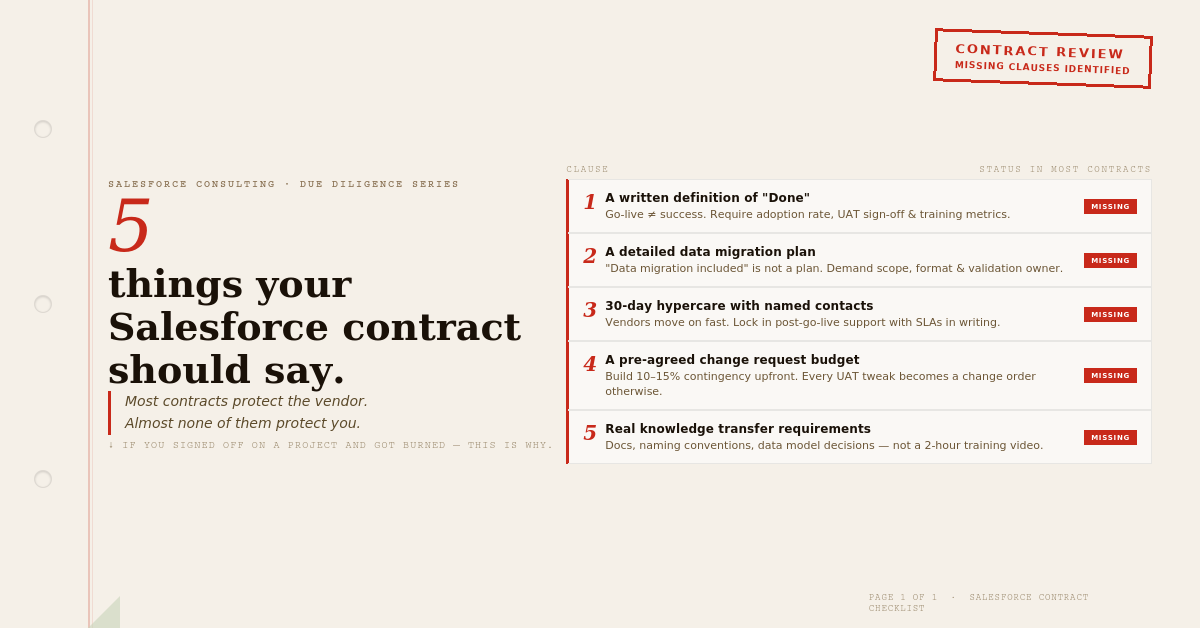
Most of them protect the vendor.
Almost none of them protect you.
Here are 5 things your contract should say — and usually doesn’t:
- Define “Done” before anyone writes a line of code.
❌ DON’T sign a contract that says “go-live” is the finish line.
✅ DO require a definition of success: adoption rate, data migration accuracy, training completion, UAT sign-off — in writing.
Real example: A mid-size logistics company paid $400K for a “completed” Salesforce build. Their sales team refused to use it. The contract said go-live happened. It did. No one defined usable.
- Data migration is not a footnote.
❌ DON’T let “data migration included” sit in one line of a 40-page SOW.
✅ DO demand a data migration plan: what data, from where, in what format, validated by whom, by when.
Real example: A professional services firm lost 6 years of account history during migration. It was “included.” The scope of what “included” meant was never defined.
- Hypercare isn’t optional — put it in the contract.
❌ DON’T assume your vendor will stick around after go-live.
✅ DO negotiate a minimum 30-day hypercare period with named support contacts and response SLAs.
Real example: A retail company went live on a Friday. By Monday, the support team had moved to a new project. 11 days of downtime followed.
- Change requests will happen. Price them now.
❌ DON’T let “any changes outside scope will be billed at $X/hour” be the only protection you have.
✅ DO negotiate a change request budget (10–15% of total project cost) built into the contract upfront.
Real example: A $250K project ballooned to $390K. Every business process tweak during UAT triggered a change order. The vendor wasn’t wrong — the contract allowed it.
- Require knowledge transfer, not just training.
❌ DON’T accept a 2-hour admin training video as “knowledge transfer.”
✅ DO specify: documentation of all customisations, naming conventions, data model decisions, and handoff to an internal owner.
Real example: A company’s lead Salesforce admin left 8 months after go-live. Nobody knew how any of it was built. A $180K re-implementation followed.
The best Salesforce implementations I’ve seen had one thing in common:
The contract was written like the vendor might disappear on day 31.
Because sometimes, they do.
Save this. Share it with whoever signs your next technology contract.
What clause do you wish you’d had? Drop it below. 👇