Book 15 Minutes
Consultation, NO FEES
222

The Salesforce feature your implementation partner forgot to mention

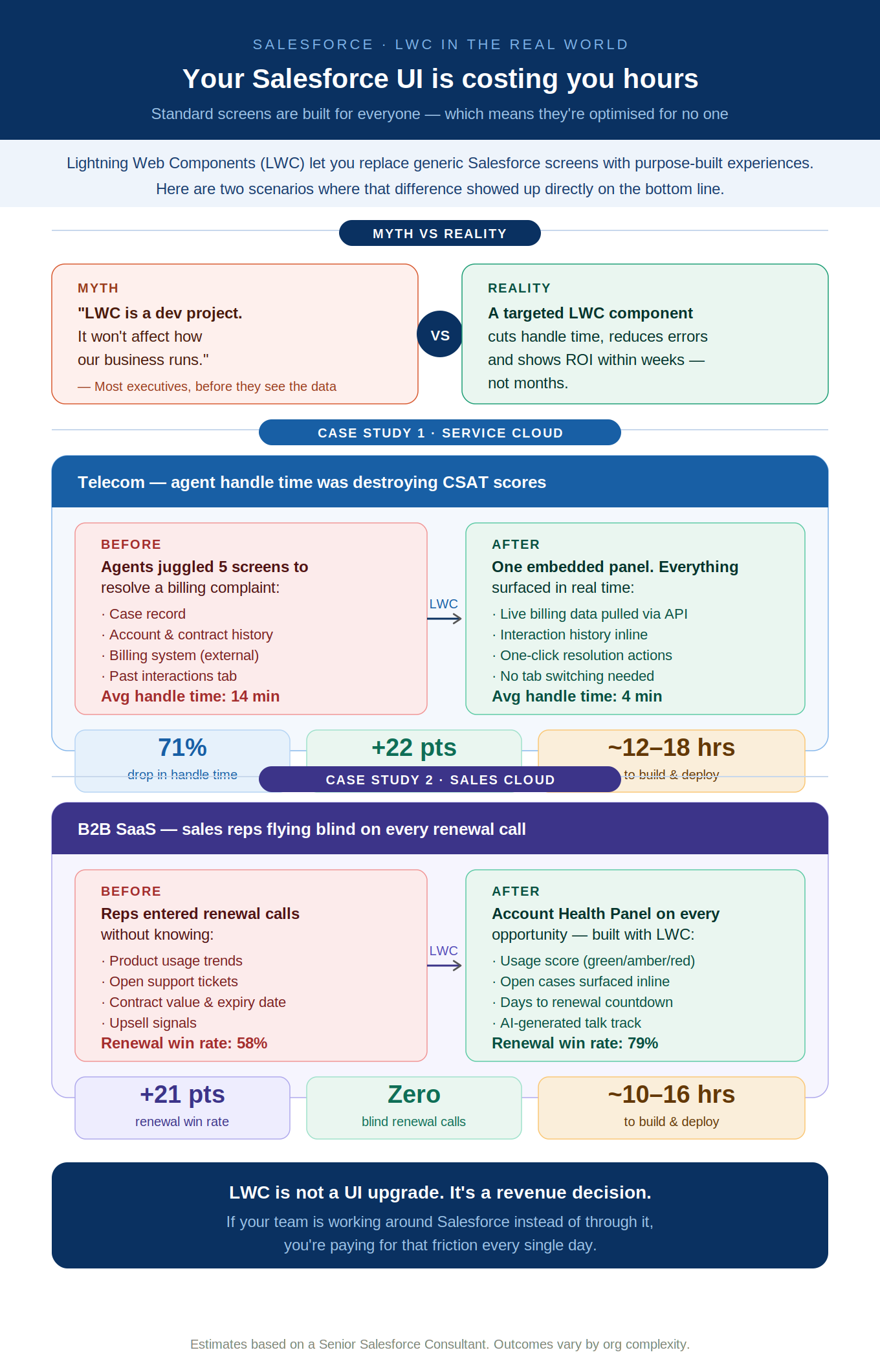
Your Salesforce agents are jumping between 5 screens to answer one customer question. Your sales reps are walking into renewal calls with zero context about the account they’re calling. Neither of these are Salesforce problems. They’re configuration problems. Lightning Web Components (LWC) let you build purpose-built panels that surface exactly the right data, at exactly the right moment — without changing your data model, your licenses, or your processes. I’ve done this twice recently: → A telecom client cut average case handle time from 14 minutes to 4 minutes. CSAT jumped 22 points.→ A B2B SaaS client went from a 58% to 79% renewal win rate — just by giving reps an account health panel before the call. Both fixes took a senior consultant under 18 hours to build and deploy. The data was already in Salesforce. The problem was no one could see it at the right time. If your team is navigating around Salesforce instead of through it — you’re paying for that friction every single day. Want to know what a targeted LWC build could look like in your org? Drop a comment or DM me.

The Salesforce feature your implementation partner forgot to mention Read Post »
20April26

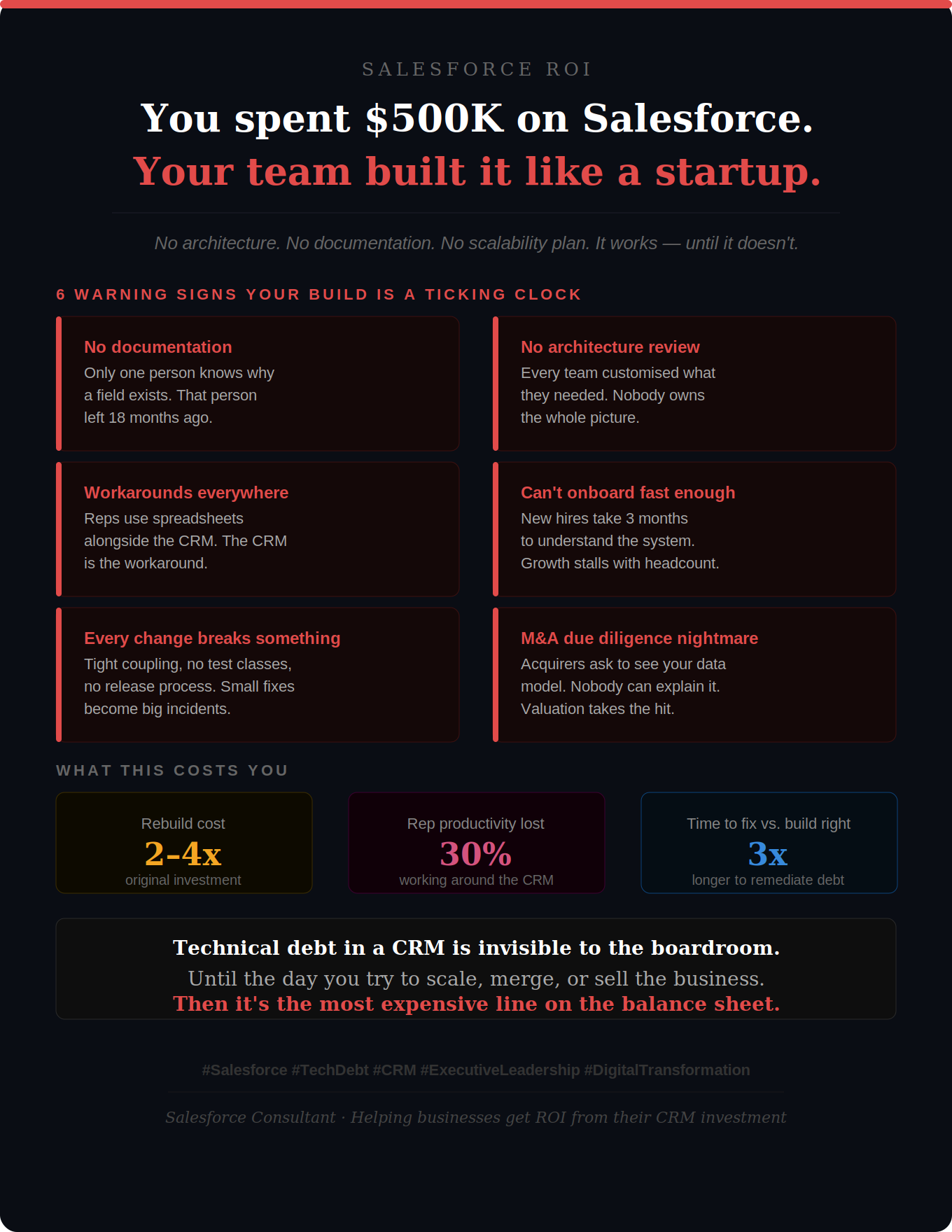
You spent $500K on Salesforce

Your team built it like a startup. No architecture review. No documentation. No scalability plan. It works — until the day it doesn’t. I see this constantly. A business invests seriously in Salesforce. The implementation gets done fast, under pressure, by a small team doing their best. And it works well enough — for a while. Then one of these moments arrives: Technical debt in a CRM is invisible to the boardroom. It doesn’t appear on any report. It doesn’t show up in any KPI. Until the moment it does — and by then it’s the most expensive line on the balance sheet. Rebuilding a poorly architected Salesforce org costs 2–4x the original investment. Remediating technical debt takes 3x longer than building it right. The cost of doing it properly upfront is always lower than the cost of fixing it under pressure. Is your Salesforce built to last — or built to survive?

You spent $500K on Salesforce Read Post »

19April2026

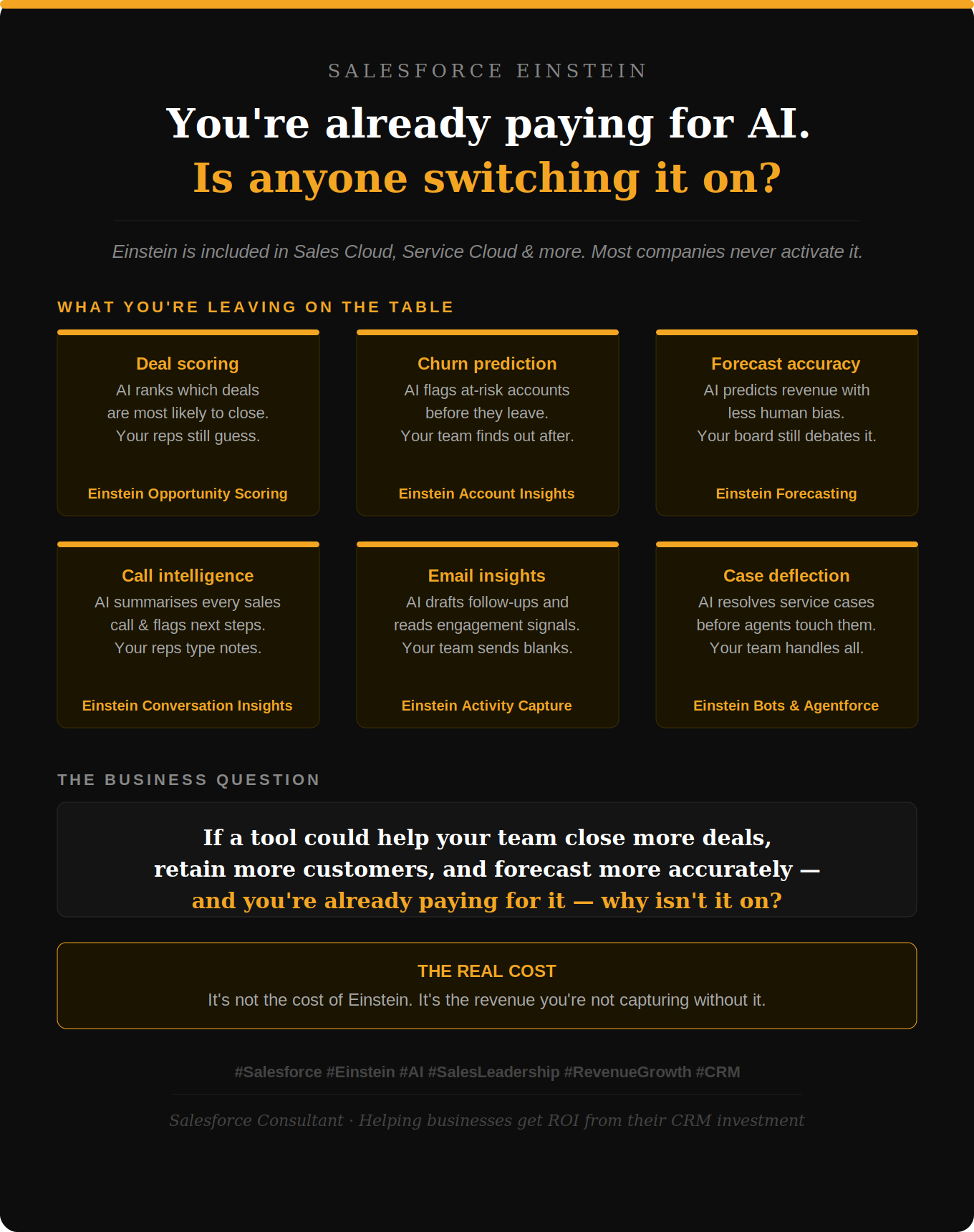
Salesforce Einstein is already in your contract

Is anyone using it? Most companies I speak to are paying for AI features they’ve never switched on. Not because they don’t want AI. Because nobody told the business what it could actually do. Here’s what’s sitting idle in your Salesforce right now: — Deal scoring that tells your reps which opportunities will close — before they waste a quarter chasing the wrong ones— Churn prediction that flags at-risk accounts before they cancel— Forecast intelligence that removes human bias from your revenue calls— Call summaries that log every conversation automatically — no more reps skipping CRM updates— Case deflection that resolves customer issues before a human agent touches them The question isn’t whether AI is ready for your business. It already is. It’s already paid for. It’s already sitting inside your Salesforce licence. The question is: who in your organisation is responsible for switching it on? If you don’t know the answer — that’s the problem. What Einstein features is your team actually using? I’d be curious to hear below.

Salesforce Einstein is already in your contract Read Post »

x 18April2026

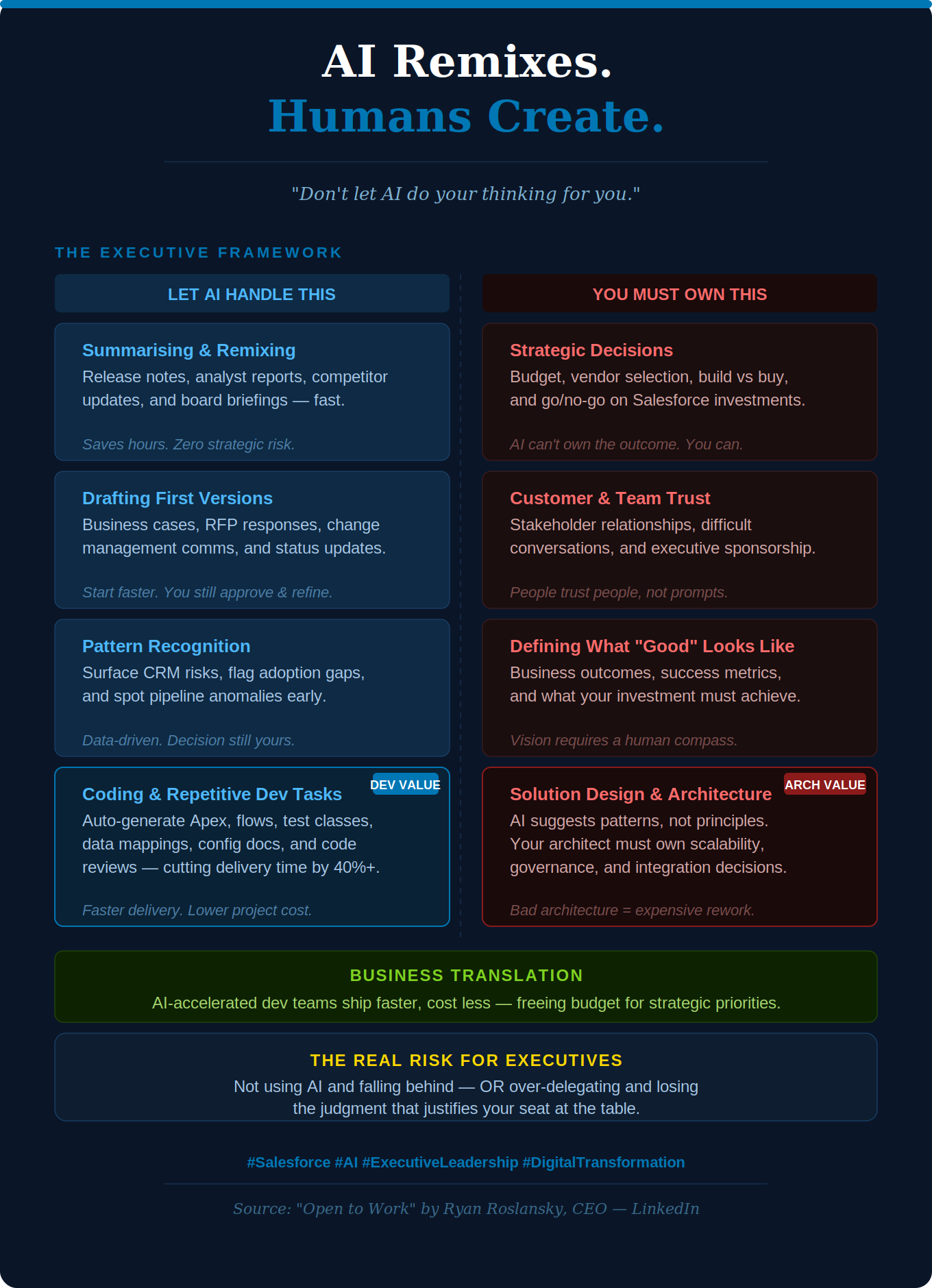
The real risk with AI is not falling behind

For businesses, The real risk with AI is not falling behind, it’s over-delegating As a Salesforce consultant, I see this play out at every level, from the boardroom to the development team. And here’s what most businesses are still missing:The ROI of AI isn’t just in productivity. It’s in what your team can stop doing. Let AI handle:-> Summarizing release notes, analyst reports & board briefings-> Drafting business cases, RFP responses & status updates-> Spotting CRM risks and pipeline anomalies before they cost you-> Writing Apex code, test classes, flows, data mappings & config docs, your developers and architects can cut delivery time by 40%+ on repetitive build work You must own:-> Budget decisions, vendor selection, build vs buy-> Customer relationships and executive sponsorship-> Defining what success looks like for your Salesforce investment-> Solution architecture, AI suggests patterns, but your architect must own scalability, governance, and integration. Bad architecture means expensive rework. The business translation?When your dev team spends less time on repetitive coding tasks, projects deliver faster and cheaper, freeing budget for the strategic work that actually moves the needle. The real risk isn’t falling behind by not using AI. It’s over-delegating to AI and losing the judgment, at every level, that your business is paying for.AI is a brilliant remix artist. But your business needs humans to be the composers. AI remixes. Humans create. Don’t let AI do your thinking for you. Source: “Open to Work” — Ryan Roslansky, CEO, LinkedIn

The real risk with AI is not falling behind Read Post »

Your Salesforce is lying to you

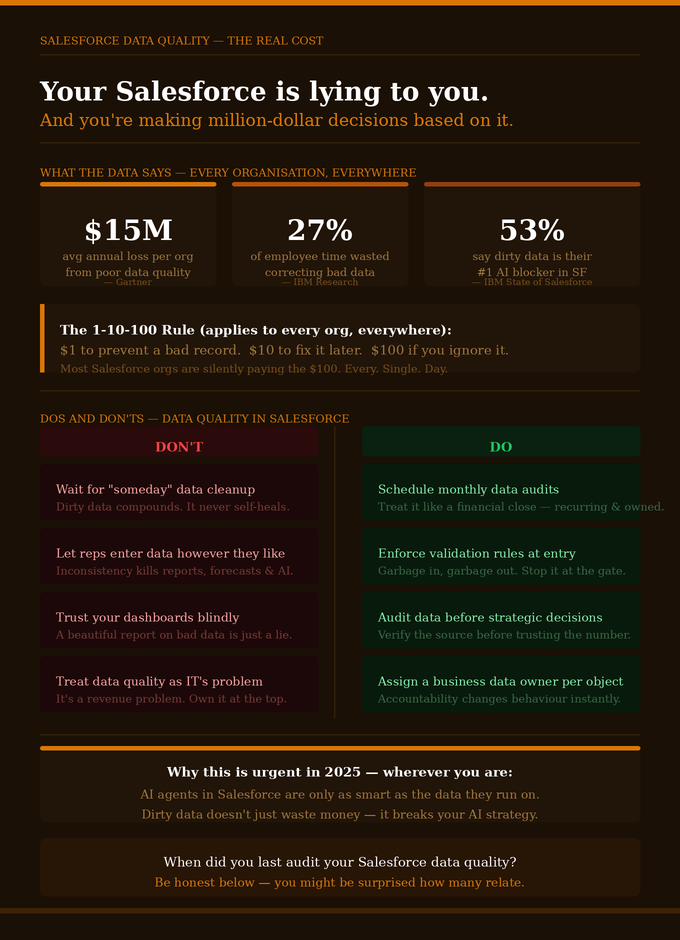
Your Salesforce is lying to you.

Your Salesforce dashboards look great. But if no one is managing data quality, you’re making decisions on fiction. Here’s what the research actually shows — and this applies to every organization, everywhere:🔴 The average business loses $15 million annually due to poor data quality — Gartner🔴 Employees waste 27% of their time correcting bad data instead of doing their jobs — IBM🔴 53% of companies say dirty data is their #1 blocker to adopting AI in Salesforce — IBM State of Salesforce And then there’s the 1-10-100 Rule. It costs:→ $1 to prevent a bad record at entry→ $10 to fix it after the fact→ $100 if you do nothing Most Salesforce orgs are silently paying the $100. Every. Single. Day. Here’s what I see in the field — the Dos and Don’ts nobody talks about:❌ DON’T wait for a “someday” cleanup project✅ DO schedule monthly data audits like a financial close — recurring, owned, non-negotiable❌ DON’T let reps enter data however they like✅ DO enforce validation rules at entry — stop garbage before it gets in❌ DON’T trust your dashboards blindly✅ DO audit your data source before making any strategic decision❌ DON’T treat data quality as IT’s problem✅ DO assign a named business owner for each critical data object in Salesforce And in 2026, this matters more than ever — wherever you are. AI agents running on Salesforce are only as smart as the data they run on. Dirty data doesn’t just waste money. It breaks your AI strategy before it even starts. When did you last audit your Salesforce data quality? Be honest in the comments — you might be surprised how many people are in exactly the same boat. Explore how AI is changing search forever.

Your Salesforce is lying to you. Read Post »

17April2026

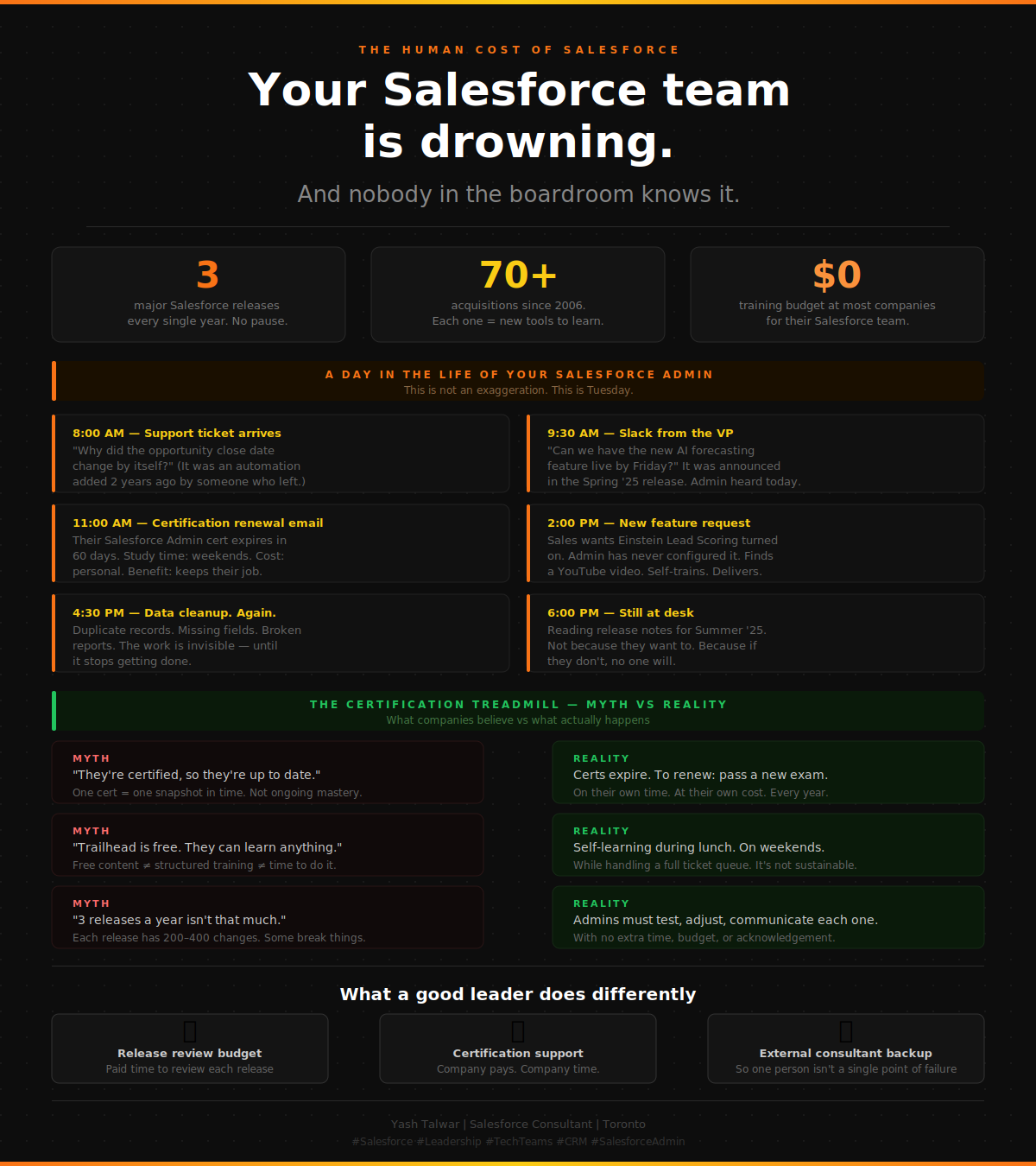
Your Salesforce team is drowning. And nobody in the boardroom knows it.

3 major releases a year. 70+ acquisitions since 2006. Hundreds of new features, deprecations, and changes, every single cycle. And now AI with APIs, MCP and CLI. They must learn it all. Who’s keeping up with all of it? Your admin & developers. On weekends. On their own time. At their own cost. Here’s what a typical Tuesday looks like for your Salesforce admin: → 8am: Investigate why an opportunity field changed by itself (automation from 2 years ago, built by someone who left)→ 9:30am: VP wants a new AI feature live by Friday. Admin heard about it today.→ 11am: Cert renewal email. 60 days to study. Personal time. Personal money.→ 2pm: New feature request. Never configured it before. Finds a YouTube video. Figures it out.→ 6pm: Still at desk. Reading Summer ’25 release notes. Because someone has to. And then there’s the certification treadmill — the part nobody talks about. Salesforce certifications expire. To keep them alive, your team must pass updated exams. Regularly. The platform changes so fast that last year’s knowledge is already partially obsolete. 💬 If you’re a Salesforce admin or developer reading this — how accurate is this? Drop a comment. Let’s make sure the people making decisions actually understand what you’re carrying. Estimate if you want an external consultant to support your team: 4–8 hrs/month retainer keeps an org healthy and your team sane.

Your Salesforce team is drowning. And nobody in the boardroom knows it. Read Post »

16April26

Your new rep is losing deals before they make their first call.

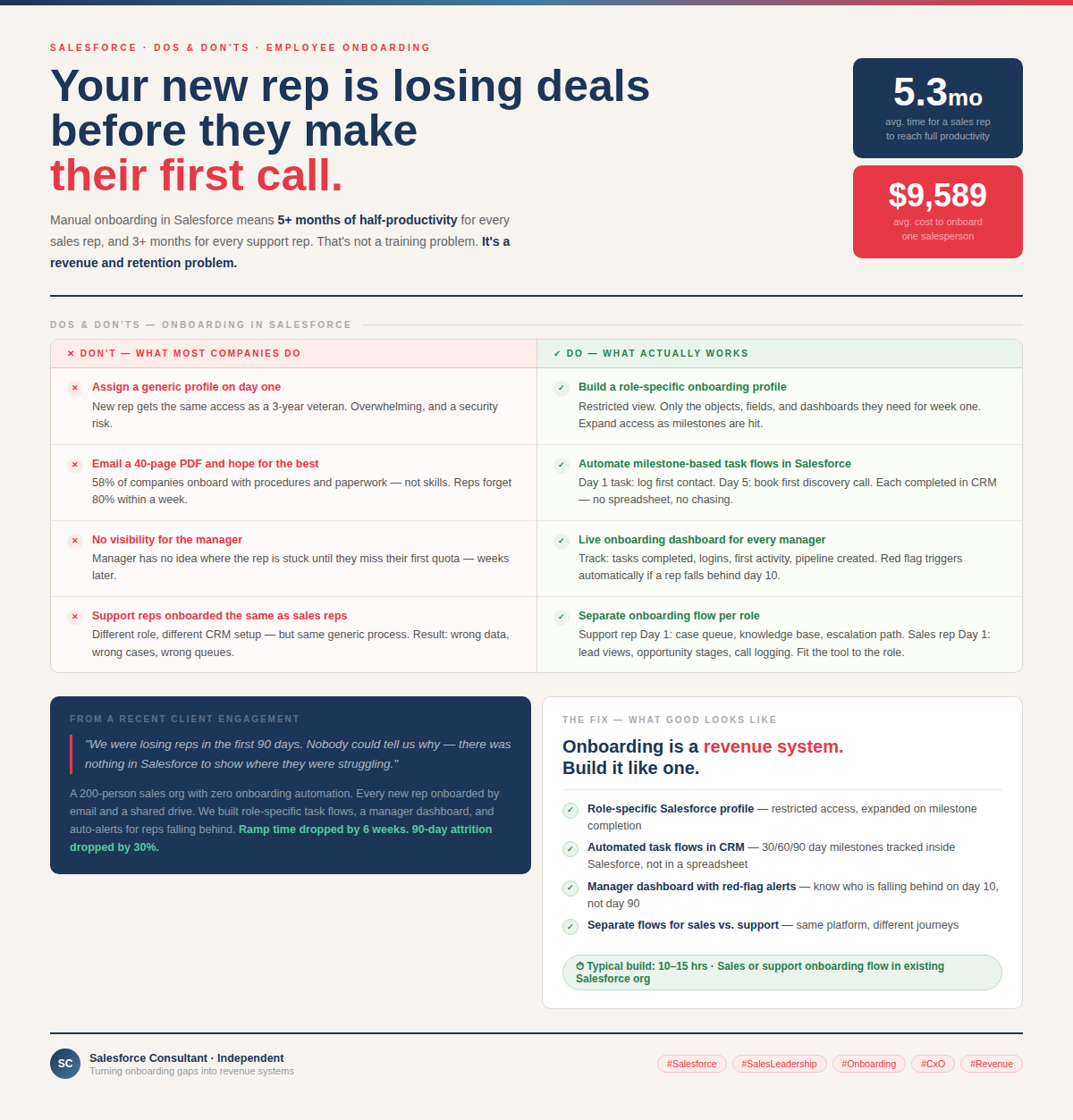
Average sales rep ramp time: 5.3 months. Average onboarding cost: $9,589 per rep. And 58% of companies spend that time and money on paperwork — not skills. That’s not a training problem. It’s a revenue problem sitting inside your Salesforce org. What most companies do wrong: ❌ Assign a generic profile on day one — same access as a 3-year veteran. Overwhelming, and a security risk.❌ Send a 40-page PDF and hope for the best — reps forget 80% within a week.❌ No visibility for the manager — they find out a rep is struggling when they miss their first quota.❌ Onboard support reps the same way as sales reps — different role, different CRM needs, same broken process. What actually works: ✅ Role-specific Salesforce profile — restricted view on day one, access expanded as milestones are hit.✅ Automated task flows in CRM — Day 1: log first contact. Day 5: book first discovery. Tracked inside Salesforce, not a spreadsheet.✅ Manager dashboard with auto alerts — know who is falling behind on day 10, not day 90.✅ Separate onboarding journeys for sales vs. support — same platform, different paths. From a recent client engagement: A 200-person sales org. Zero onboarding automation. New reps were leaving in the first 90 days and nobody could show where they were struggling — there was nothing in Salesforce to track it. We built role-specific task flows, a manager dashboard, and red-flag alerts for reps falling behind. Ramp time dropped by 6 weeks. 90-day attrition dropped by 30%. ⏱ This typically takes 10–15 hours to build in an existing Salesforce org. 💬 Does your Salesforce actually track where new reps are in their first 90 days — or is that still a spreadsheet?

Your new rep is losing deals before they make their first call. Read Post »

15April26

The demo was flawless. The board applauded. Six months later it was quietly shelved.

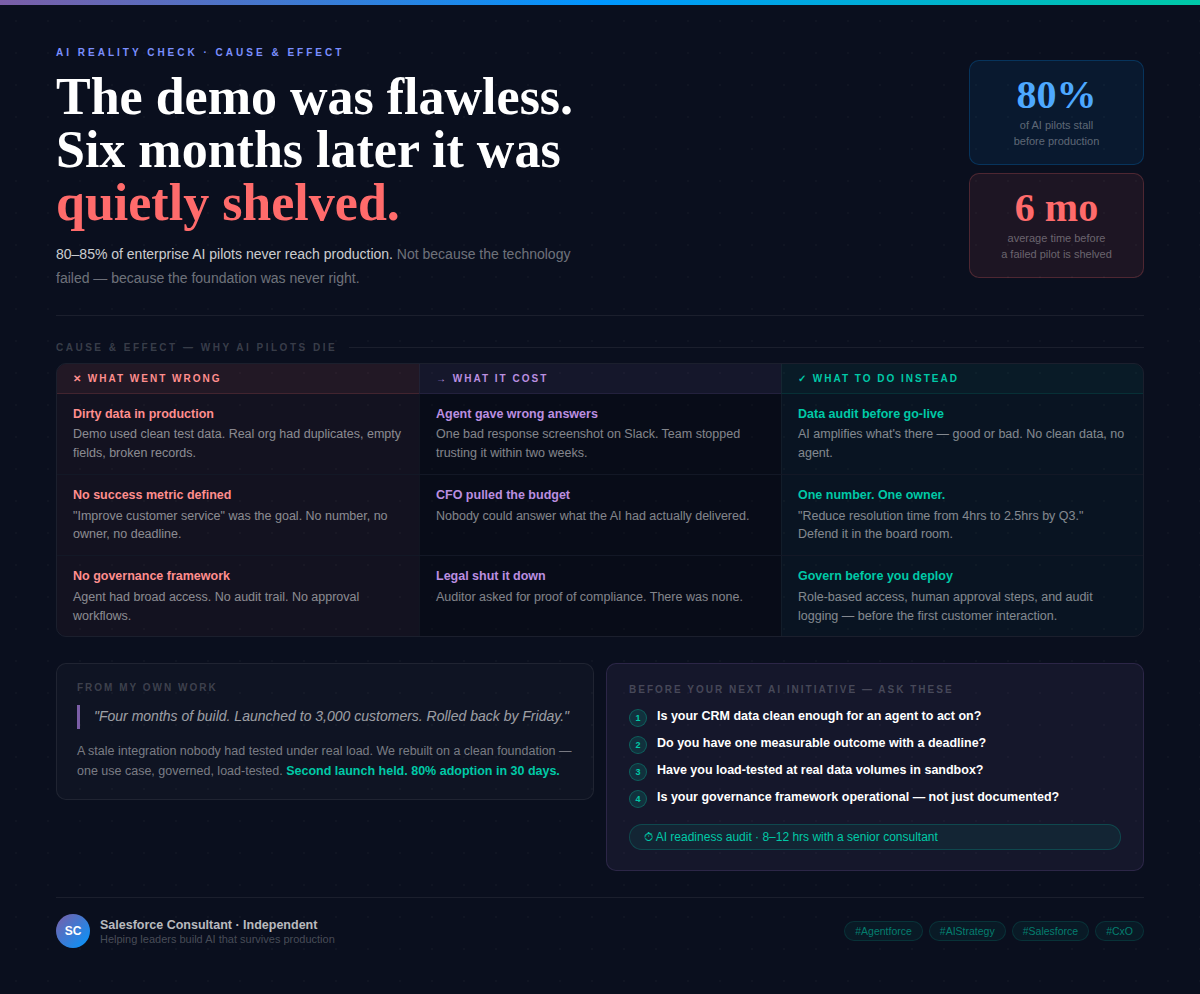
80% of enterprise AI pilots never reach production. Not because the technology failed — because the foundation wasn’t right. I watched a retail client spend 4 months building an Agentforce agent. Launched to 3,000 customers. Rolled back by Friday. A stale integration nobody had tested under real load. We rebuilt on a clean foundation — one use case, governed, load-tested. Second launch held. 80% adoption in 30 days. Three things that kill AI pilots: ❌ Dirty data → agent gives wrong answers → team stops trusting it in week two❌ No success metric → CFO pulls budget → nobody can say what it delivered❌ No governance → legal shuts it down → couldn’t prove compliance when asked Before your next AI initiative — four questions: If any answer is no — fix the foundation first. The agent will follow. ⏱ AI readiness audit: 8–12 hrs with a senior consultant. 💬 What broke first in your AI pilot?

The demo was flawless. The board applauded. Six months later it was quietly shelved. Read Post »

14April26

Your most critical Salesforce employee is the one you never listen to

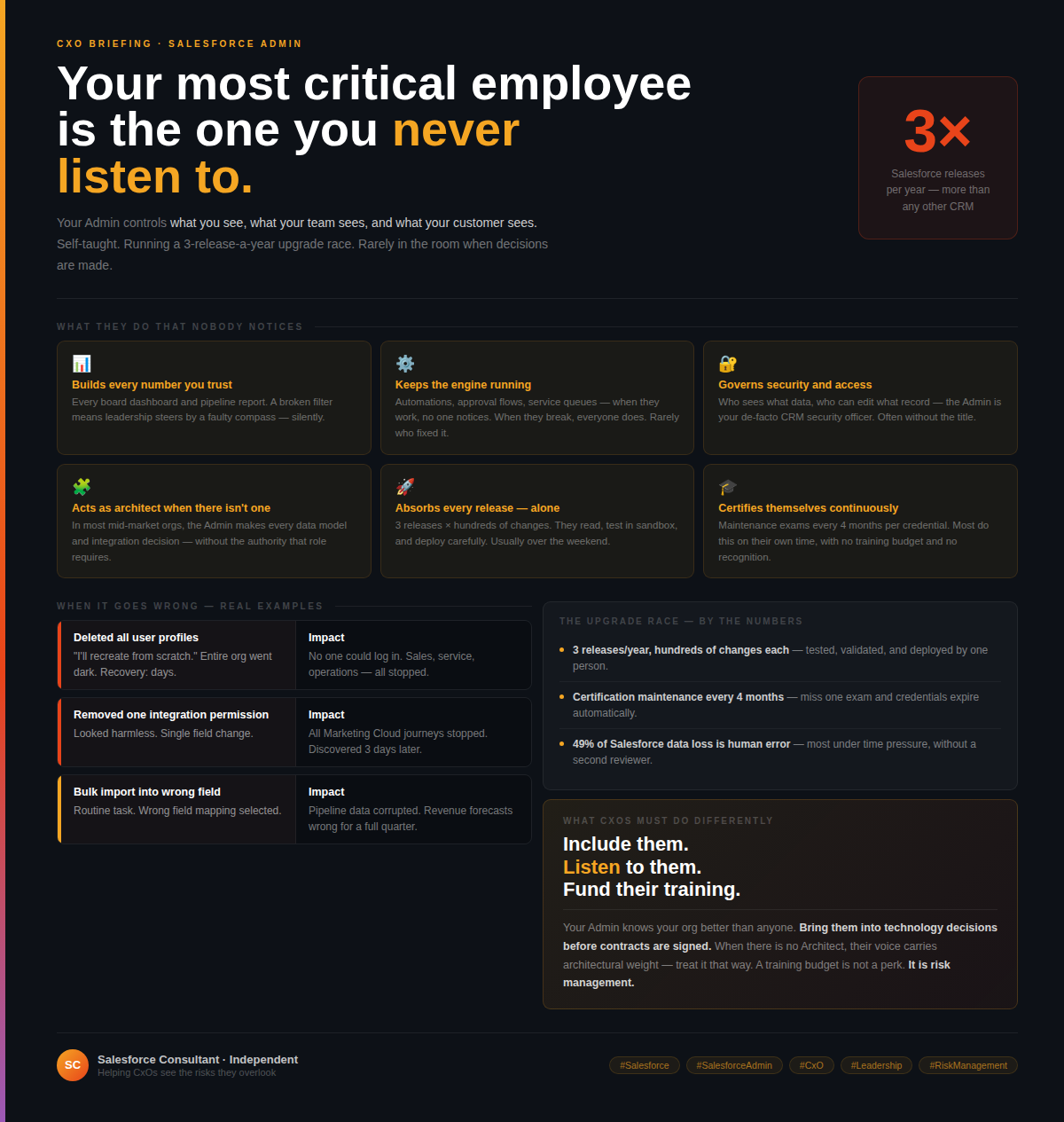
They control what you see. What your team sees. What your customer sees. What they do that nobody notices: → Every board dashboard and pipeline number — built by them. A broken filter and leadership steers blind.→ Every automation, approval flow, and service queue — when it works, no one notices. When it breaks, everyone does. Rarely who fixed it.→ They are your de-facto security officer for CRM access and data governance. Usually without the title.→ In most mid-market orgs, they make every architecture and integration decision — without the authority that role demands.→ 3 major Salesforce releases per year. Hundreds of changes each. Read, tested, deployed. Usually over the weekend.→ Certification maintenance every 4 months. Their own time. No budget. No recognition. When it goes wrong — it goes wrong fast: What needs to change: Bring your Admin into technology decisions before contracts are signed — not after. When there is no Architect, their voice carries architectural weight. Treat it that way. A training budget is not a perk. It is risk management. 💬 Does your Admin get a seat at the table when CRM decisions are made?

Your most critical Salesforce employee is the one you never listen to Read Post »

Scroll to Top