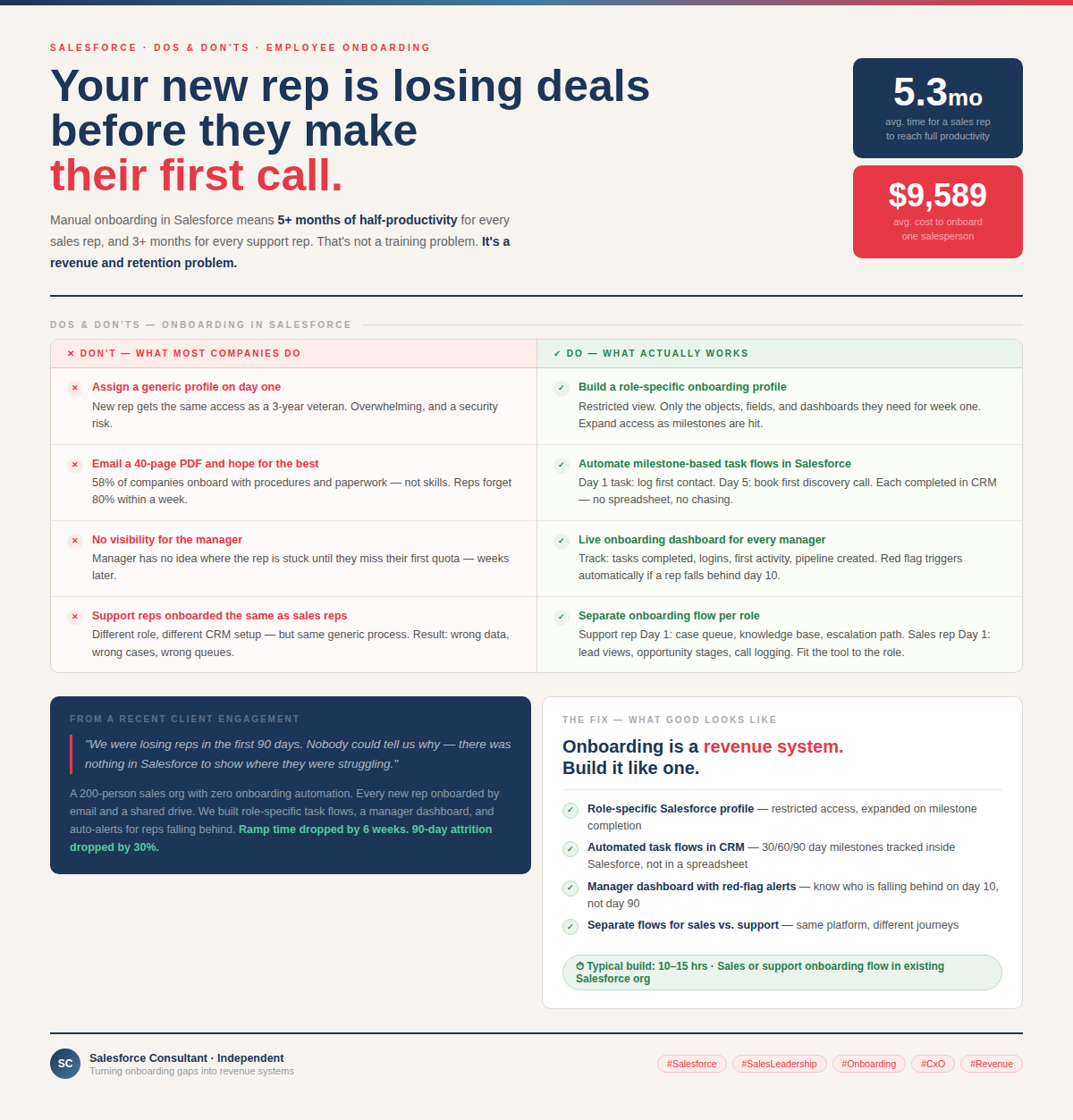
Average sales rep ramp time: 5.3 months. Average onboarding cost: $9,589 per rep. And 58% of companies spend that time and money on paperwork — not skills.
That’s not a training problem. It’s a revenue problem sitting inside your Salesforce org.
What most companies do wrong:
❌ Assign a generic profile on day one — same access as a 3-year veteran. Overwhelming, and a security risk.
❌ Send a 40-page PDF and hope for the best — reps forget 80% within a week.
❌ No visibility for the manager — they find out a rep is struggling when they miss their first quota.
❌ Onboard support reps the same way as sales reps — different role, different CRM needs, same broken process.
What actually works:
✅ Role-specific Salesforce profile — restricted view on day one, access expanded as milestones are hit.
✅ Automated task flows in CRM — Day 1: log first contact. Day 5: book first discovery. Tracked inside Salesforce, not a spreadsheet.
✅ Manager dashboard with auto alerts — know who is falling behind on day 10, not day 90.
✅ Separate onboarding journeys for sales vs. support — same platform, different paths.
From a recent client engagement:
A 200-person sales org. Zero onboarding automation. New reps were leaving in the first 90 days and nobody could show where they were struggling — there was nothing in Salesforce to track it.
We built role-specific task flows, a manager dashboard, and red-flag alerts for reps falling behind. Ramp time dropped by 6 weeks. 90-day attrition dropped by 30%.
⏱ This typically takes 10–15 hours to build in an existing Salesforce org.
💬 Does your Salesforce actually track where new reps are in their first 90 days — or is that still a spreadsheet?