It’s failing because of you.
That’s uncomfortable. But the data doesn’t lie.
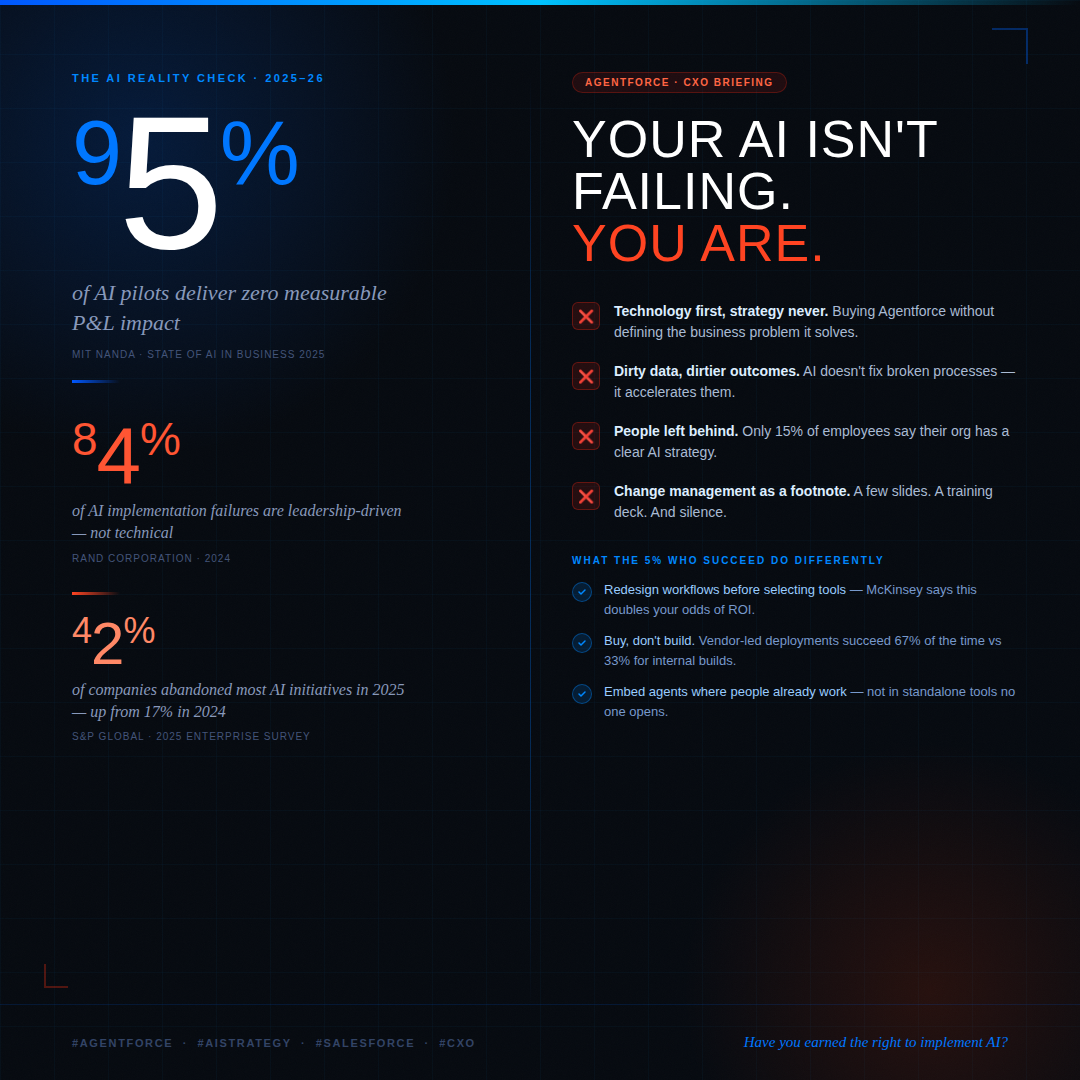
More than 80% of AI projects fail — that’s twice the failure rate of non-AI technology projects. RAND And 95% of organizations running AI pilots are seeing zero return on their P&L. ComplexDiscovery
- You read that right. 95%.
- Yet 92% of executives plan to increase AI spending over the next three years. FullStack
- We are collectively pouring money into a burning building and calling it a renovation.
So what’s actually broken?
Here’s what no one in your boardroom is saying out loud:
❌ Problem 1: You bought the technology before defining the problem.
A senior IBM research scientist put it plainly: “People said, ‘Step one: we’re going to use LLMs. Step two: What should we use them for?'” FullStack
This is the single most expensive mistake in enterprise AI. Agentforce is not a strategy. It’s a tool. And a tool without a job is just overhead.
❌ Problem 2: Your data is a disaster — and you know it.
“Loads of Salesforce orgs were built the ‘quick and cheap’ way, which isn’t scalable. Before a company can take on AI, they often need to clean that up. There are also data issues, broken processes, and understaffed teams — all of which make it hard to adopt something like Agentforce.” Salesforce Ben
AI doesn’t fix broken processes. It accelerates them. Feed your agent garbage data and you’ll get garbage decisions — at scale, at speed.
❌ Problem 3: Your people were never brought along.
Business Insider named employee resistance the biggest AI barrier in 2025. But it’s not fear of the technology — it’s fear of being sidelined, judged, or replaced. Whatfix
Only 15% of employees say their workplace has communicated a clear AI strategy. FullStack
You announced a transformation. You didn’t explain what it meant for the person sitting in seat 14B of your open plan office.
❌ Problem 4: You treated change management as a footnote.
McKinsey’s data is blunt: only 30% of change initiatives succeed — and that number hasn’t moved in a decade. Aquiva Labs Most organisations still treat adoption like a communication problem. A few slides. A training session. Done.
It’s not done. It’s barely started.
Here’s what the 5% who succeed actually do differently:
✅ They redesign end-to-end workflows before selecting technology. McKinsey confirms that organizations reporting significant financial returns are twice as likely to have done this. WorkOS
✅ They buy rather than build. Purchasing AI tools from specialized vendors succeeds 67% of the time. Internal builds succeed only one-third as often. Fortune
✅ They empower line managers — not just central AI labs — to drive adoption. Fortune
✅ They embed agents into existing channels where employees already work, rather than launching standalone tools that sit unused. ERP Today
The real question for every CXO in 2026 is not:
“Are we using Agentforce?”
It’s:
“Have we earned the right to use it?”
Have you cleaned your data? Have you redesigned your processes? Have you had an honest conversation with your teams about what this means for their roles? Have you defined what success actually looks like in numbers — not vibes?
If the answer to any of those is no — your implementation was always going to fail. The technology just made it faster and more expensive.
The companies winning with AI right now didn’t start with the model. They started with the mess — and fixed it first.
That’s the unglamorous, unsexy truth that nobody puts on a Dreamforce slide.
What’s the biggest people or process blocker you’re seeing in AI rollouts right now? Drop it in the comments — let’s make this a real conversation.