Even before you’ve picked up the phone, Salesforce has already internally booked a 10% increase on your account. Most CTOs and IT leaders walk into that conversation with nothing. No license data. No usage audit. No benchmark. Just the number on the email — and a rep who sounds very friendly.
Here’s what’s actually happening:
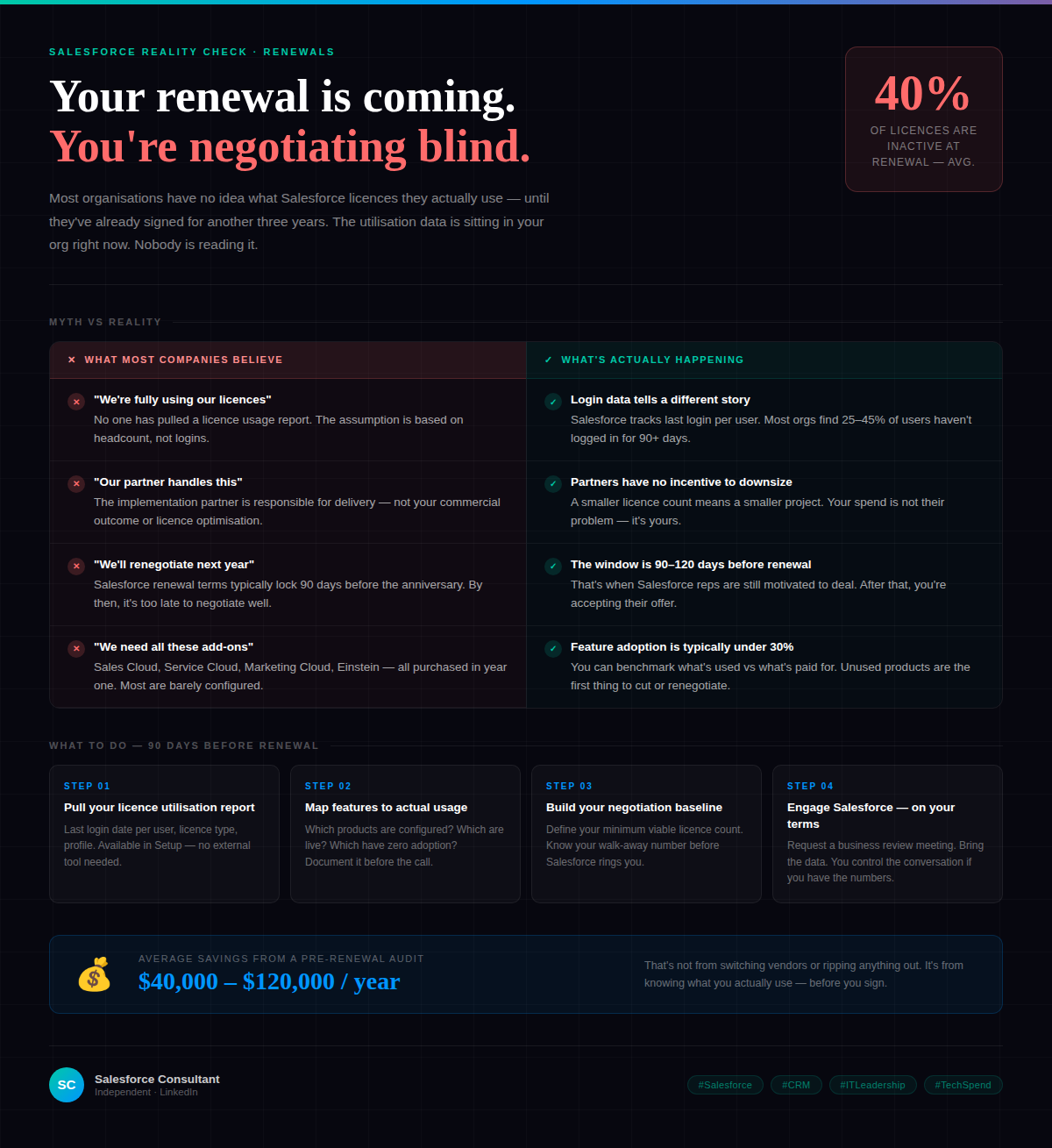
❌ “We’re fully using our licences”
→ 25–45% of licensed users haven’t logged in for 90+ days. The data is in your Setup page. Nobody is looking.
❌ “We can reduce licences if we need to”
→ If you try to reduce from 100 to 80 users, Salesforce raises the per-user rate to protect total revenue. Per-user hikes of 30–50% have been documented. Without a reduction provision clause in your contract, you have no protection whatsoever.
❌ “The 7–8% uplift is manageable”
→ A $150,000 contract at 7% annual uplift becomes $212,000 in five years. With no new users. No new features. Add consultant dependency, storage overages, and add-on repricing — and the real annual increase is often 12–18%.
❌ “We’ll renegotiate next year”
→ The window is 90–120 days before renewal. That’s when Salesforce reps are still motivated to deal. Salesforce’s fiscal year ends January 31 — Q4 reps are the most flexible. After the renewal lands, you’re accepting their offer.
❌ “We need all these add-ons”
→ Feature adoption across most orgs is under 30%. Salesforce bundles products into renewal offers to mask price increases. Ask for itemised pricing. Remove anything not fully deployed before you sign.
The average savings from a pre-renewal audit: $40,000 – $120,000 per year.
Not from switching. Not from a project. Just from knowing what you actually have — before you’re asked to sign for three more years of it.
💬 Have you ever pulled a licence utilisation report before a Salesforce renewal? What did you find?